
Climate-Resistant Bridal Beauty: The South Florida Bride’s Complete Guide

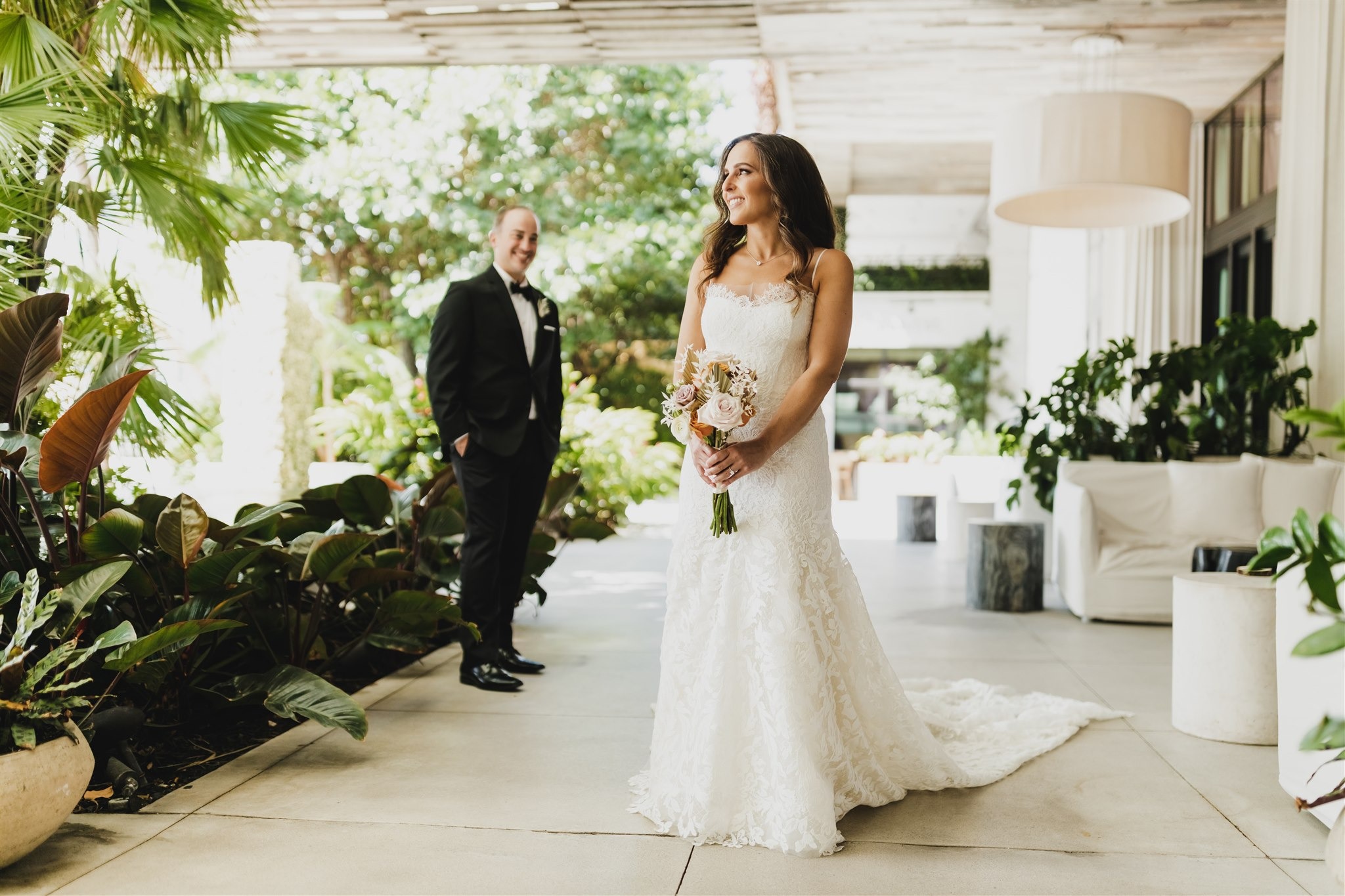
There’s a version of Florida wedding planning that treats the weather as a detail to manage, and there’s a version that treats it as a fundamental design constraint that shapes every beauty decision you make. Brides who succeed are almost always in the second group.
South Florida’s climate isn’t just “hot.” It’s a specific combination of persistent high humidity, intense heat from May through September, salt air at coastal venues, afternoon storm risk for half the year, and the particular challenge of moving between outdoor ceremony spaces and air-conditioned receptions that can differ by 20 degrees or more. Each of those factors changes what holds, what doesn’t, and what choices your stylist needs to make on your behalf.
This guide covers that whole picture: climate-adapted approaches for both hair and makeup, how venue type changes the equation, what the seasons mean for your planning, and how to use your trial to actually test your look rather than just preview it.
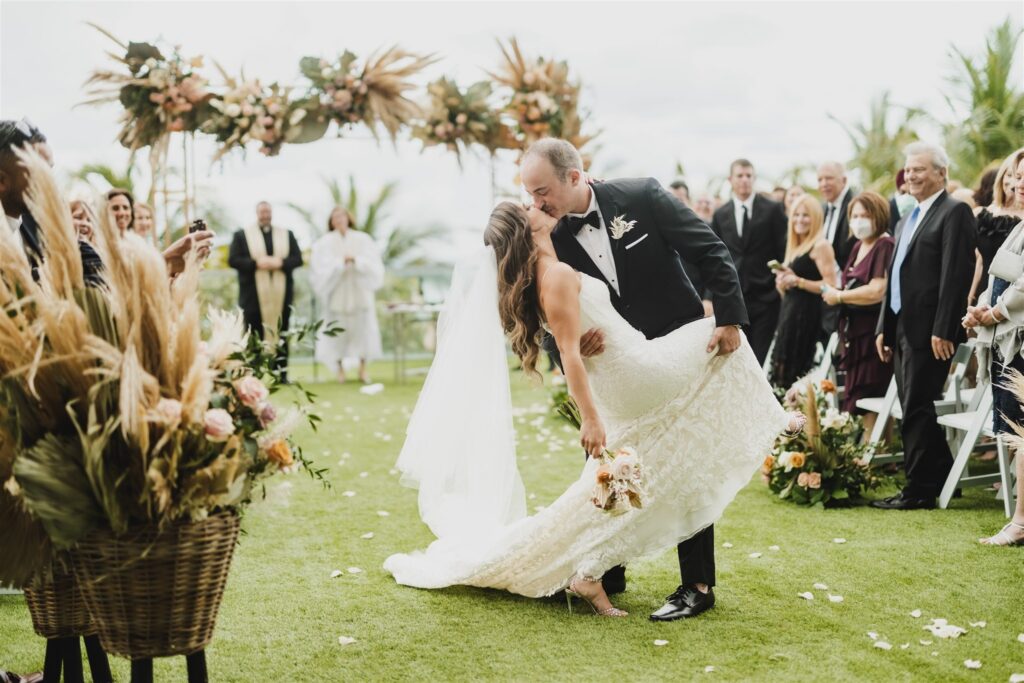
Why South Florida Is a Different Beauty Environment (Not Just “Hot Weather”)
When a beauty guide says “protect your makeup in heat,” it’s usually talking about a generic warm summer day in a temperate climate. South Florida in July is a different category of challenge, and understanding why helps explain why generic tips don’t fully work here.
The Combination: Heat, Humidity, Salt Air, and Rain Risk
Most warm wedding destinations have one or two of the environmental factors that challenge bridal beauty. South Florida in peak season often has all of them simultaneously.
Summer humidity regularly exceeds 80%, which means there is more moisture in the air than skin and makeup products are typically engineered to handle. The heat index, which is the felt temperature combining air temperature and humidity, regularly exceeds 100°F from June through August. At waterfront venues, salt air from the Atlantic or the Intracoastal Waterway adds a layer of environmental stress to both hair and makeup. And from June through October, afternoon storms are a real enough probability that outdoor wedding planners build rain contingency plans as a standard part of the process.
How South Florida’s Climate Compares to Other Popular Wedding Destinations
A destination wedding in Tuscany in summer is hot. A wedding in the Bahamas is humid. A beach wedding in California has salt air. None of them combine all four factors at the intensity South Florida reaches during peak summer months.
This is relevant because products, techniques, and style choices developed by stylists who primarily work in other climates may not fully account for what happens here. The strategies in this guide are specific to the South Florida context, not general warm-weather advice.
What “Humidity-Resistant” Actually Needs to Mean Here
Humidity-resistant, for practical purposes here, means a product system that holds its structure and appearance while being continuously exposed to above-80% ambient humidity for six to ten hours, with intermittent direct sun, natural perspiration, and possibly brief salt air exposure. That’s a higher bar than most product descriptions of “humidity-resistant” are written to address.
Achieving it requires a system approach: not one product that is humidity-resistant, but a layered stack where every component contributes to the overall system’s durability.
The Specific Challenge of Indoor/Outdoor Venue Transitions
One of the more underappreciated challenges is the transition between outdoor ceremony spaces and air-conditioned indoor reception venues. When you move from 90-degree outdoor humidity into 72-degree air conditioning, the rapid temperature change causes condensation to form on the skin’s surface. This can affect both how makeup looks immediately after the transition and how hair products respond to the humidity change.
Planning for this transition, including a touch-up window between the ceremony and reception entrance, is part of the climate-adapted beauty strategy for any venue that includes both outdoor and indoor components.
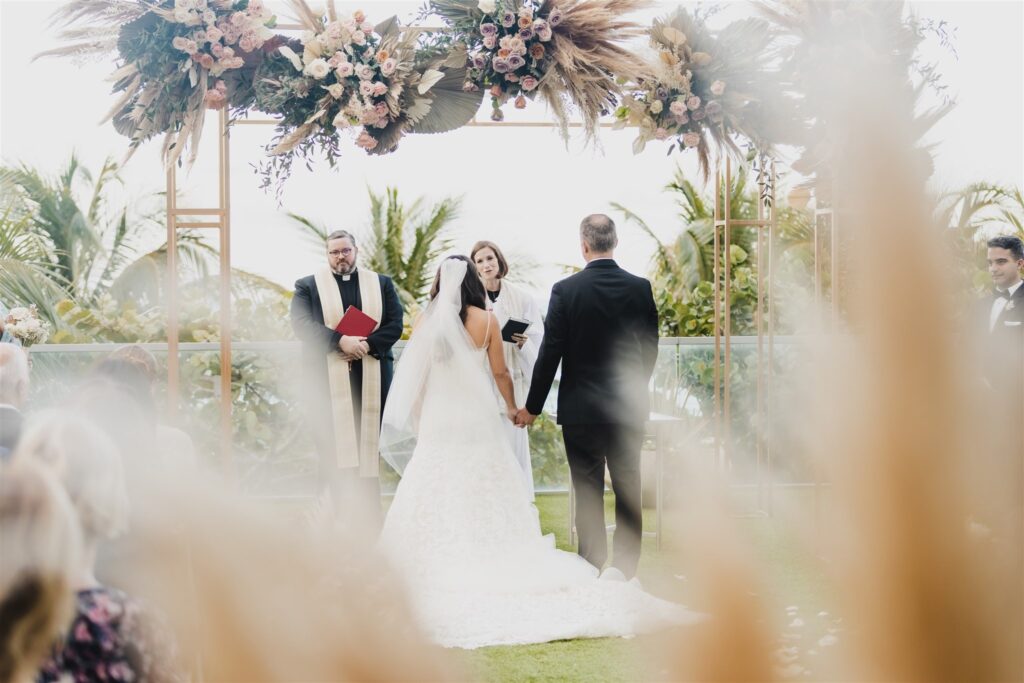
Seasonal Timing and What It Changes
When you’re getting married in South Florida matters as much as where, from a beauty-planning standpoint.
Peak Summer (June–September): The Highest Humidity, Afternoon Rain Risk, Maximum Heat
Peak summer requires the most climate-adapted approach. Heat indexes above 100°F, humidity above 80%, and afternoon thunderstorms that can develop within an hour of a clear morning all require specific planning choices. Product stacks need to be engineered for maximum performance, styling choices should favor structure and hold over loose movement, and outdoor ceremony timing ideally avoids the peak heat window of noon to 3pm.
For outdoor summer ceremonies, an on-site concierge stylist is less of a luxury and more of a practical necessity. The conditions are simply too demanding to expect morning-applied makeup and hair to remain untouched through a full evening reception without professional attention.
Shoulder Seasons (April–May and October): More Manageable, but Still Demanding
April, May, and October offer more moderate conditions, but South Florida’s shoulder season is still significantly warmer and more humid than most North American cities. The same climate-adapted product system applies, with slightly more flexibility in styling choices for hair. Loose styles that wouldn’t hold well in a July outdoor ceremony have better chances in an October evening event.
Rain risk in October is decreasing but not eliminated, as hurricane season runs through November 30. April and May carry lower rain probability but rising humidity and temperature as the wet season approaches.
South Florida “Winter” (November–March): The Ideal Window and Why It Still Requires Planning
The November through March period is the most comfortable window for outdoor South Florida weddings. Humidity is lower, temperatures are in the 70s–low 80s, and rain probability is minimal. This is the season when loose bridal hair styles that would struggle outdoors in July have their best chance, and when the product stack can be slightly less extreme in its heat resistance engineering.
That said, “winter” in South Florida is still warmer and more humid than a summer wedding in many northern cities. The climate-adapted approach still applies; it’s simply less demanding.
Hurricane Season Awareness: Rain Planning for Outdoor Ceremonies
If your outdoor ceremony falls between June 1 and November 30, a rain contingency is not optional planning. This doesn’t mean your ceremony will be rained out; the majority of South Florida summer weddings proceed beautifully without weather interruption. It means that the planning process should include a realistic backup plan, and that beauty choices should account for the possibility of brief exposure to rain even if the ceremony itself proceeds outdoors.
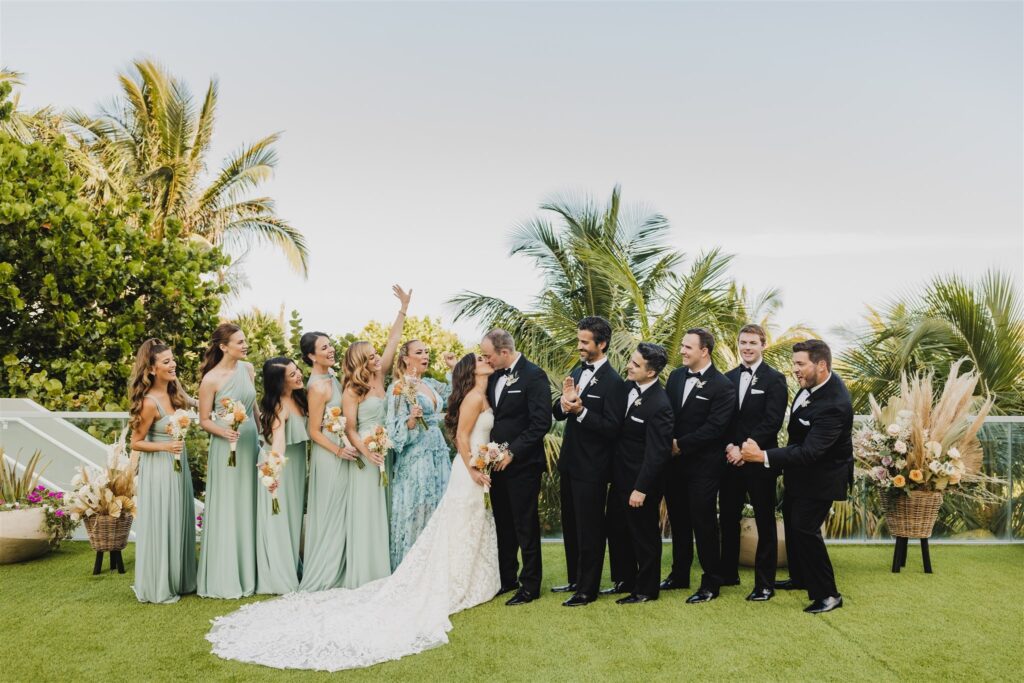
Climate-Adapted Bridal Hairstyling
Hair is arguably where the climate challenge is most visible. A product and technique system can hold makeup through significant environmental stress. Hair is more physically vulnerable to wind, humidity, heat, and moisture.
The Structure Principle: Why Some Styles Hold and Others Don’t
The most important concept in climate-adapted bridal hairstyling is structure. A structured hairstyle has architecture built into it: a framework of pins, braids, or internal supports that maintains the shape of the look regardless of what the environment does to the surface texture. An unstructured style relies on the hair itself maintaining its shape, which it will do until humidity, heat, or wind disrupts it.
In a climate-controlled indoor setting, an unstructured style can be beautiful and hold through a long event. In South Florida outdoor conditions, the same style starts compromising within an hour. Structure is the variable that separates the two outcomes.
Updos and Structured Styles: Your Best Friend in Heat and Humidity
A well-built updo is the most climate-resistant bridal hairstyle option for most brides having outdoor summer ceremonies. The architecture of a pinned updo holds regardless of what the humidity does to the surface; the shape is maintained by internal structure, not by the hair’s natural texture pattern staying intact.
Beyond hold, updos work particularly well at outdoor and waterfront venues because they keep hair away from the face and neck, which affects both comfort and photography. In bright outdoor light, clean facial framing reads more clearly than hair that’s moving and potentially obscuring the face in some frames.
Loose and Flowing Styles: When They Work and When They Don’t
Loose, flowing bridal hair is one of the most requested and most beautiful options in bridal beauty. It also has the most specific conditions under which it holds well in South Florida.
Loose styles work best in the November through March period, at indoor or partially sheltered venues, or for brides who are comfortable with the style evolving through the day in ways that can be managed with planned touch-ups. In peak summer, at fully outdoor or waterfront venues, even professionally set loose styles will begin to change their shape within an hour of outdoor exposure.
This isn’t a reason to rule out loose styles entirely. It’s a reason to be honest about what the style will look like at hour four versus hour one, and to decide whether that evolution is acceptable or whether a second look transition during the reception would address it.
Half-Up Styles in a Humid Climate
Half-up styles sit between updos and fully loose styles in terms of climate performance. The secured portion holds regardless of humidity. The loose portion responds to the environment the way any loose hair does.
For shoulder-season or winter outdoor ceremonies, half-up styles perform very well. For peak summer, they’re a reasonable choice if the ceremony is shorter or if there’s partial shade, with the understanding that the loose portion will need refreshing during the reception transition.
How Coastal and Waterfront Venues Change the Hair Planning Equation
Coastal and waterfront venues add sea breeze to the standard Florida heat and humidity challenge. A light, consistent breeze sounds pleasant, and it is, but it continuously delivers ambient moisture and movement to the hair that an inland outdoor venue doesn’t. The breeze can also make certain updo structures more visible as loose pieces are caught and moved.
At a waterfront venue in summer, a structured updo with careful attention to flyaways and face-framing pieces is the most reliable approach. Your artist will use stronger-hold finishing products and more securing pins than they would for an inland venue. Salt air also responds differently to certain hairspray formulas, which is something an experienced South Florida stylist factors into their product choices.
Managing Extensions in South Florida Humidity
Bridal hair extensions can be a beautiful addition, providing length or volume that natural hair can’t achieve. In South Florida conditions, they require specific management.
The main consideration is the bond or weft type and how it responds to humidity and perspiration. Some bonding methods are more humidity-stable than others. An experienced stylist who regularly places extensions in South Florida conditions will know which application methods hold best and which products help maintain the extension’s integration with the natural hair through a long outdoor day.
Extensions also need their own trial, not just a try-on. The trial should include time in warm conditions so both the stylist and the bride can assess how the extensions are behaving before the wedding day.
Products and Techniques That Create Hold in Real Conditions
Strong-hold hairsprays, anti-humidity serums, and humidity-blocking finishing products are the functional tools for climate-adapted hairstyling. The specific combination depends on the hair type, the style, and the venue conditions. An experienced South Florida stylist knows which products perform in these conditions from direct application experience, not from product descriptions.
For most outdoor summer styles, the finishing product protocol is more intensive than it would be for an indoor event. This isn’t about stiff, product-heavy hair; it’s about targeted application in the structural areas that most need support while keeping the visible surface texture natural.
The Outdoor-to-Indoor Transition: Styling for Both
If your venue includes both outdoor ceremony and indoor reception, your hairstyle needs to work across both environments. This is usually straightforward for structured updos. For looser styles, the reception transition is the natural moment for a second look: the ceremony ends, a brief portrait session happens, and the stylist refreshes or transitions the hair before the reception entrance.
Planning this in advance with both your stylist and your photographer ensures the transition happens smoothly without rushing the portrait session or delaying the reception entrance.
Climate-Adapted Bridal Makeup
The detailed product-by-product approach to heat-resistant bridal makeup is covered fully in the how to make bridal makeup last all day in Florida heat guide. This section covers the systemic and planning perspective: how to think about makeup choices in the context of your full South Florida wedding day.
The Full-System Approach (Not Just One Tip)
The most common mistake brides make when preparing for a warm outdoor wedding is changing one product (“I’ll wear waterproof mascara”) without thinking about the full system. One heat-resistant product in a stack of non-heat-resistant products doesn’t produce meaningfully different results at hour four.
Climate-adapted bridal makeup works as a system: primer creates grip, foundation bonds to primer rather than skin, powder creates a barrier against oil, setting spray locks the system in place, and waterproof formulas protect the eye and lip products that are most vulnerable to moisture. Each layer contributes. Remove any one, and the overall performance degrades.
Primer, Foundation, and Setting as an Integrated System
A silicone-based primer creates the barrier that everything above it depends on. A long-wear or airbrush foundation bonds to that barrier and resists moisture breakdown in a way that standard formulas don’t. Setting powder, strategically applied, manages oil production. Setting spray, applied in two passes over the completed look, creates the final moisture-resistant film.
These four components are the core of the system. The eye and lip products layer on top of that system, and they need to be in waterproof or long-wear formulas to match the performance level of the base.
Waterproof Products: Where They’re Non-Negotiable
At an outdoor summer ceremony in South Florida, waterproof mascara and waterproof liner are non-negotiable. The combination of heat, humidity, and the very real possibility of tears during the ceremony is enough to migrate non-waterproof eye products significantly. This is visible in photography in a way that’s difficult to address in post-production.
Waterproof formulas for concealer and foundation are available and appropriate for the highest-demand outdoor conditions. For most applications, the system approach described above provides sufficient protection without requiring every single product to be waterproof.
What “Humidity-Resistant” Foundation Actually Means in Practice
A foundation described as humidity-resistant or long-wear has been formulated with film-forming ingredients or polymers that create a more durable surface than a standard emulsion formula. In practice, in South Florida conditions, humidity-resistant foundation holds its coverage and appearance for two to three hours longer than standard foundation would under the same conditions when all other layers in the system are appropriate.
This matters significantly for photography. The ceremony is usually one to two hours in. First-look portraits happen before. If the makeup holds cleanly through the ceremony and portrait session and needs a professional touch-up before the reception, that’s a completely successful outcome. If the foundation is breaking down during the ceremony itself, no amount of touch-up fully recovers the look.
Managing the Makeup-to-Photography Transition: Indoor vs. Outdoor Lighting
Outdoor photography and indoor photography are different environments for how makeup reads. Products that look stunning in golden hour natural light can appear harsh under flash photography. Products that look skin-like under indoor artificial light can read as flat in bright outdoor sun.
Your trial is the right time to test both lighting environments, not the wedding day. Ask your photographer (or take your own photos during the trial) in both indoor and outdoor conditions so you can see what the camera actually captures.
Touch-Up Planning as Part of the Climate Strategy
Touch-up planning is climate management, not an afterthought. In outdoor South Florida conditions, plan for at least one professional touch-up window between the ceremony end and the reception entrance. This is the most important touch-up of the day: it’s when the look is refreshed to reception-ready quality and, if applicable, when the second look transition happens.
Venue Type and Its Impact on Your Beauty Approach
The same bride with the same products and the same stylist will need different style and product choices depending on whether she’s marrying in a garden estate, a waterfront pavilion, or an air-conditioned ballroom.
Fully Outdoor Garden or Estate Ceremony
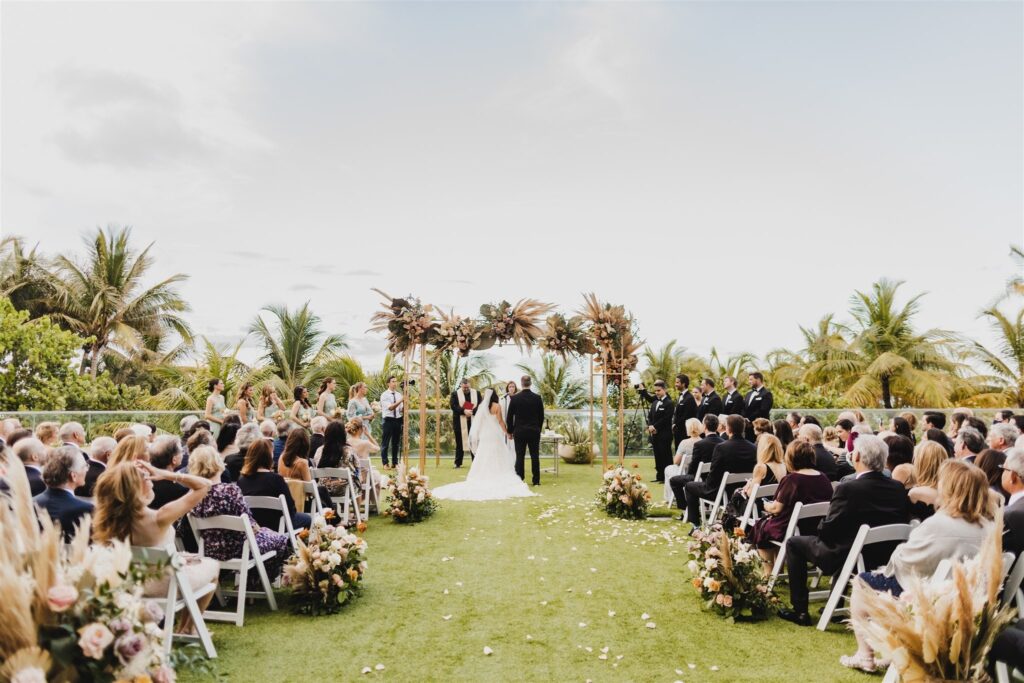
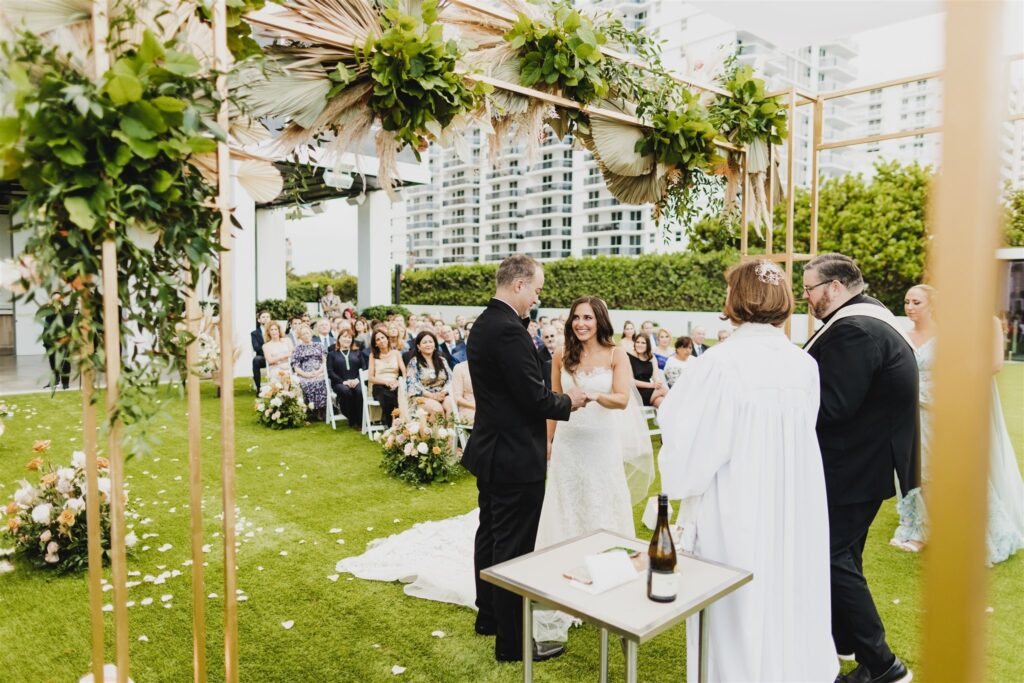
Maximum climate resistance required across all categories. Structured updo or very strong-hold styling for hair. Full system approach for makeup with waterproof products throughout. On-site stylist through at minimum the ceremony-to-reception transition. Portrait session timing ideally avoids the noon-to-3pm peak heat window.
Waterfront or Coastal Venue
Everything in the outdoor category above, plus salt air considerations for hair product selection, plus attention to the specific wind patterns at the venue. Your stylist should know or ask about the venue’s exposure level. A covered pavilion at a waterfront estate has very different wind exposure than an open dock or beachfront ceremony site. The makeup system is the same; the hair approach may be more heavily structured.
Covered Pavilion or Open-Air Structure
A covered outdoor structure provides meaningful protection from direct sun while still exposing hair and makeup to ambient humidity and any breeze that moves through. This is a step down in demand from a fully outdoor ceremony, but still significantly more demanding than an indoor event. The same system approach applies; the timing pressure on touch-ups is slightly less acute.
Air-Conditioned Indoor Ceremony and Reception
The most forgiving environment for bridal beauty. Indoor air conditioning reduces humidity dramatically and eliminates the direct sun and heat factors. Product choices have more flexibility here, and loose hair styles are more viable. A climate-adapted system is still appropriate because the morning of preparation happens before arriving at the air-conditioned venue, and because even indoor humidity in Florida is higher than in most northern states.
Mixed Indoor/Outdoor Venue with Both Elements
The transition challenge discussed above applies most directly here. Planning the touch-up window at the indoor/outdoor junction is essential. If the ceremony is outdoors and the reception is indoors, the portrait session transition is the key window. If the cocktail hour is outdoors and the reception dinner is indoors, a touch-up before entering the reception is worth planning.
The Ceremony-to-Reception Transition
The transition window between ceremony and reception entrance is the most important touch-up and refresh opportunity of the wedding day, and it’s the one most brides don’t fully plan for.
Moving from Outdoor to Indoor Air Conditioning: What Happens
When you move from outdoor heat and humidity into a significantly cooler air-conditioned space, the skin adjusts to the temperature change rapidly. This adjustment can cause light condensation on the makeup surface, minor foundation sheering in areas where oil has accumulated during the outdoor portion, and hair that has responded to the outdoor conditions and may need resetting before the reception entrance.
A brief touch-up window of 15 to 20 minutes during the transition addresses all of this: blotting where needed, refreshing the lip color, resetting any flyaways, and applying a light pass of setting spray to re-seal the system.
How to Plan the Second Look or Touch-Up in This Context
If you’re planning a second look, the ceremony-to-reception transition window is when it happens. This is when your all-day stylist transitions the hair from the ceremony updo to the reception style (which might be letting the updo down into waves, switching accessories, or going from a formal pinned style to a softer textured version) and shifts the makeup to match the evening energy.
Planning this in advance with your stylist, your photographer, and your venue coordinator ensures the timing works. The photographer should know to plan portrait session timing around the transition. The coordinator should know the reception entrance time accounts for the transition window.
Managing Shine and Heat During Outdoor Portrait Sessions
Outdoor portrait sessions in summer conditions produce genuine heat and genuine photography conditions. Some shine during an outdoor portrait session is normal and even flattering in golden hour light; it reads as luminosity rather than breakdown. Excessive shine that results in foundation breakdown reads differently.
Having oil-blotting sheets accessible during the portrait session, and knowing to use them before the camera rather than trying to eliminate all shine by adding powder, keeps the look photography-ready without the heavy-product appearance that over-powdering creates.
Using Your Bridal Trial to Test the Climate
The trial is not a preview. It’s a test, and to be useful as a test, it needs to test the right things.
What to Replicate at the Trial That Your Wedding Day Conditions Will Bring
If your ceremony is outdoors in summer, find ways to expose the trial look to similar conditions. Step outside after the trial is done and spend an hour in the heat. Take photographs in natural outdoor light, not just under the salon’s artificial lighting. Give the look a chance to respond to real conditions before deciding whether the system is working.
If your venue is a waterfront property, and if it’s practical, consider spending time near water during the trial window to see how the look holds in coastal conditions.
What to Ask Your Artist About Climate Performance
Ask your stylist: what specific products are you using for heat and humidity resistance? What would you change in this product stack if the forecast shows a particularly hot and humid day? How does this updo hold under outdoor conditions? What’s your plan if the setting spray I’m wearing isn’t providing enough hold?
These conversations produce better results on the wedding day than any last-minute improvisation.
Why the Trial Should Be Taken Seriously as a Test, Not Just a Preview
A trial done only in a comfortable air-conditioned environment produces information about how the look appears, not about how it performs. For a South Florida outdoor wedding, performance is the variable that matters more. A beautiful look that holds for two hours isn’t the right outcome. A beautiful look that holds for ten hours is.
The All-Day Concierge Advantage in a South Florida Climate
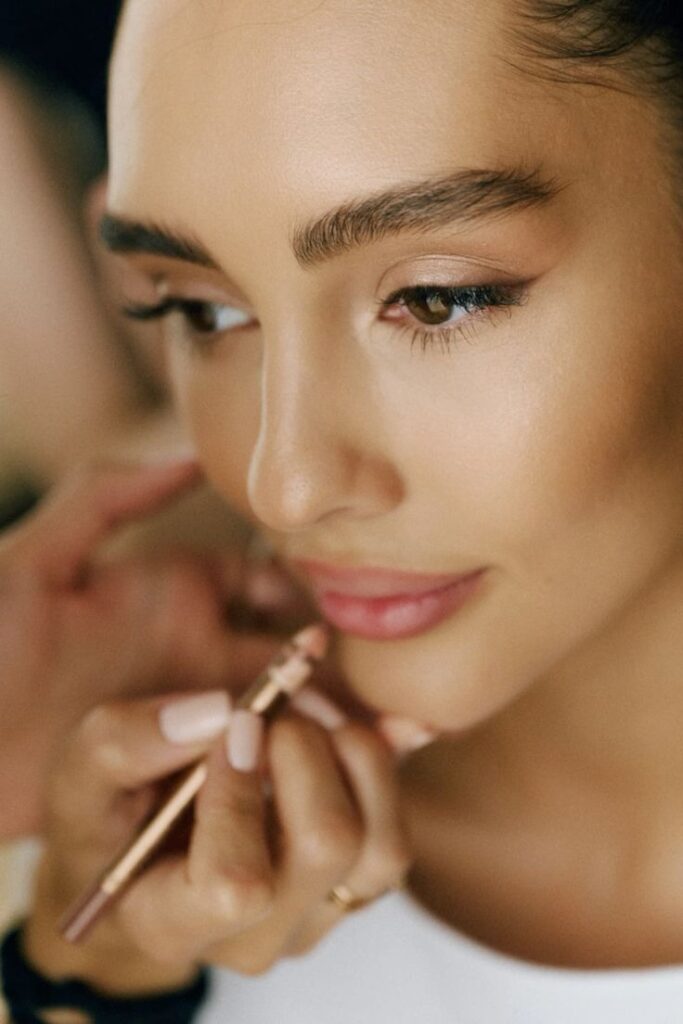
In most wedding markets, an all-day beauty concierge is a meaningful upgrade. In South Florida’s peak outdoor season, it shifts from upgrade to practical climate management infrastructure.
Why Climate Management Doesn’t End After the Initial Application
The climate challenges that affect your makeup and hair don’t stop when the morning prep ends. They’re continuous throughout the outdoor ceremony, the portrait session, the cocktail hour, and the reception entrance. A look built to hold through all of that still benefits from professional attention at the key transition points.
What On-Site Climate Adjustments Actually Look Like
During the ceremony, a concierge stylist is available at the edge of the venue to address anything that needs attention at the start or end of the ceremony. During the portrait session, they’re on-site to manage blotting, touch-up, and any hair that has responded to the outdoor conditions. At the ceremony-to-reception transition, they execute the second look or refresh and have the look reception-ready before the entrance.
None of this is visible to guests. The result is a bride who walks into the reception looking the way she did at the ceremony, which is not the default outcome for a South Florida outdoor summer wedding without professional support.
What You Gain When a Professional Is With You Through the Whole Day
The practical gain is the appearance and the photographs. The less quantifiable gain is peace of mind. Knowing that a professional who built your look is available through the entire day removes a category of worry from a day that has enough to think about.
For everything included in an all-day service, the complete all-day bridal beauty concierge guide covers it in detail.
Booking Conversations to Have with Your Stylist
The information your stylist needs about your climate conditions should enter the conversation at the very beginning, not as an afterthought during the trial.
What to Tell Your Artist at Initial Inquiry
Share your venue name, whether the ceremony is indoor or outdoor, and the month of your wedding. These three pieces of information immediately tell an experienced South Florida stylist what the climate baseline is for your day and what product and technique approach is appropriate. A stylist who knows they’re preparing for a July outdoor ceremony at a waterfront estate is making different decisions from the first conversation than one who hears “indoor December wedding.”
What to Discuss at the Trial Regarding Climate and Venue
At the trial, revisit your venue conditions specifically. Discuss which products are being chosen for their climate performance and why. Ask to see the product selection for your application and understand the system. This isn’t micromanaging: it’s informed participation in your own outcome.
If the weather forecast for your wedding weekend shifts toward more extreme conditions (a heat wave, higher-than-typical humidity), that conversation should happen with your stylist in advance so the product choices can be adjusted if needed.
The Climate-Aware Portfolio Review: What to Look For
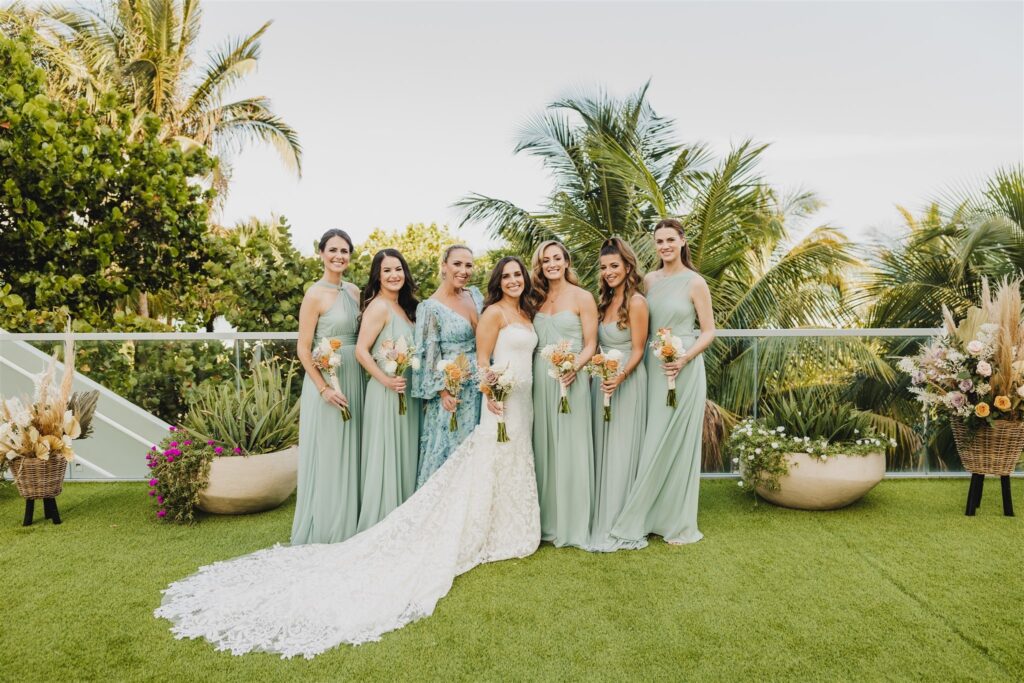
When reviewing a potential stylist’s portfolio, look specifically for outdoor South Florida weddings in warm months. A beautiful portfolio of indoor winter weddings demonstrates skill; it doesn’t demonstrate climate performance. Look for outdoor ceremony photographs and check whether the hair and makeup in those images looks consistent between the early ceremony photos and the later reception shots. That consistency is the evidence of climate-adapted work.
Frequently Asked Questions
What makes South Florida weather different from other warm wedding destinations?
South Florida combines persistent high humidity above 80%, intense summer heat, afternoon rain risk from June through October, and, at coastal venues, salt air and sea breeze. It’s the combination of these factors, not any single one, that requires a specifically adapted beauty approach. Many destinations have one or two of these elements. South Florida’s peak season often delivers all of them at once.
Which bridal hairstyles hold best in South Florida humidity?
Structured updos and pinned styles hold most reliably. They resist humidity that breaks down wave or curl patterns in looser styles, and they hold against sea breeze at waterfront venues. Loose styles can work beautifully in the drier months (November through March) and at indoor or partially sheltered venues. A skilled stylist uses climate-appropriate products and techniques to extend the hold of any style, but the structure of the style itself is the most important factor for outdoor summer conditions.
How does venue type change the approach to bridal beauty in South Florida?
Significantly. A fully outdoor garden ceremony in July requires maximum humidity and heat resistance from both hair and makeup. A coastal or waterfront venue adds salt air. A covered pavilion provides partial protection and allows slightly more flexibility. An air-conditioned ballroom allows the most options. The transition between outdoor and indoor spaces is its own consideration. Your stylist should know your venue type before making any product or style recommendations.
When is the best time of year to get married in South Florida for bridal beauty purposes?
November through March is the most manageable window. Humidity is lower, temperatures are moderate, and rain risk is minimal. April and May are shoulder season with moderate conditions. June through October is the wettest and hottest period, requiring the most climate-adapted planning. This doesn’t mean summer weddings can’t be beautiful. Hundreds of gorgeous South Florida weddings happen in July and August. They simply require more specific product choices and an experienced artist who knows how to build for those conditions.
What should I test at my bridal trial specifically for South Florida conditions?
Replicate your actual conditions as closely as possible. If you’re having an outdoor summer wedding, test your look in natural heat rather than an air-conditioned salon. Wear the trial look for at least four to six hours and photograph yourself in natural light. Give the look a chance to respond to the conditions before evaluating whether the system is working.
Does having an all-day stylist help manage South Florida’s climate specifically?
Yes, in ways that go well beyond standard touch-up service. An on-site artist monitors how the climate is affecting your look in real time, makes adjustments during portrait sessions, manages the transition when you move from outdoor to indoor, and executes the second look or refresh at the ceremony-to-reception window. The climate here is variable enough that having a professional present through the full day provides genuine peace of mind.
Plan Your Climate-Adapted Wedding Beauty with Phairis Luxury
Rebecca Mousseau and the Phairis Luxury team have been doing outdoor, waterfront, and estate weddings across South Florida for 18+ years. Every product choice and styling decision we make is based on what actually holds in these conditions, tested across hundreds of real weddings.
Start the conversation about your date, your venue, and your vision by reaching out here.
For more on planning your South Florida wedding beauty:
To be iconic?
Ready
I'm excited to hear all about your wedding/Event day. Have a question about a booking and hair styling sessions? View our services and talk to us, also dont forget to check our portfolio
