
On-Site Wedding Hair and Makeup: What Your Wedding Morning Actually Looks Like

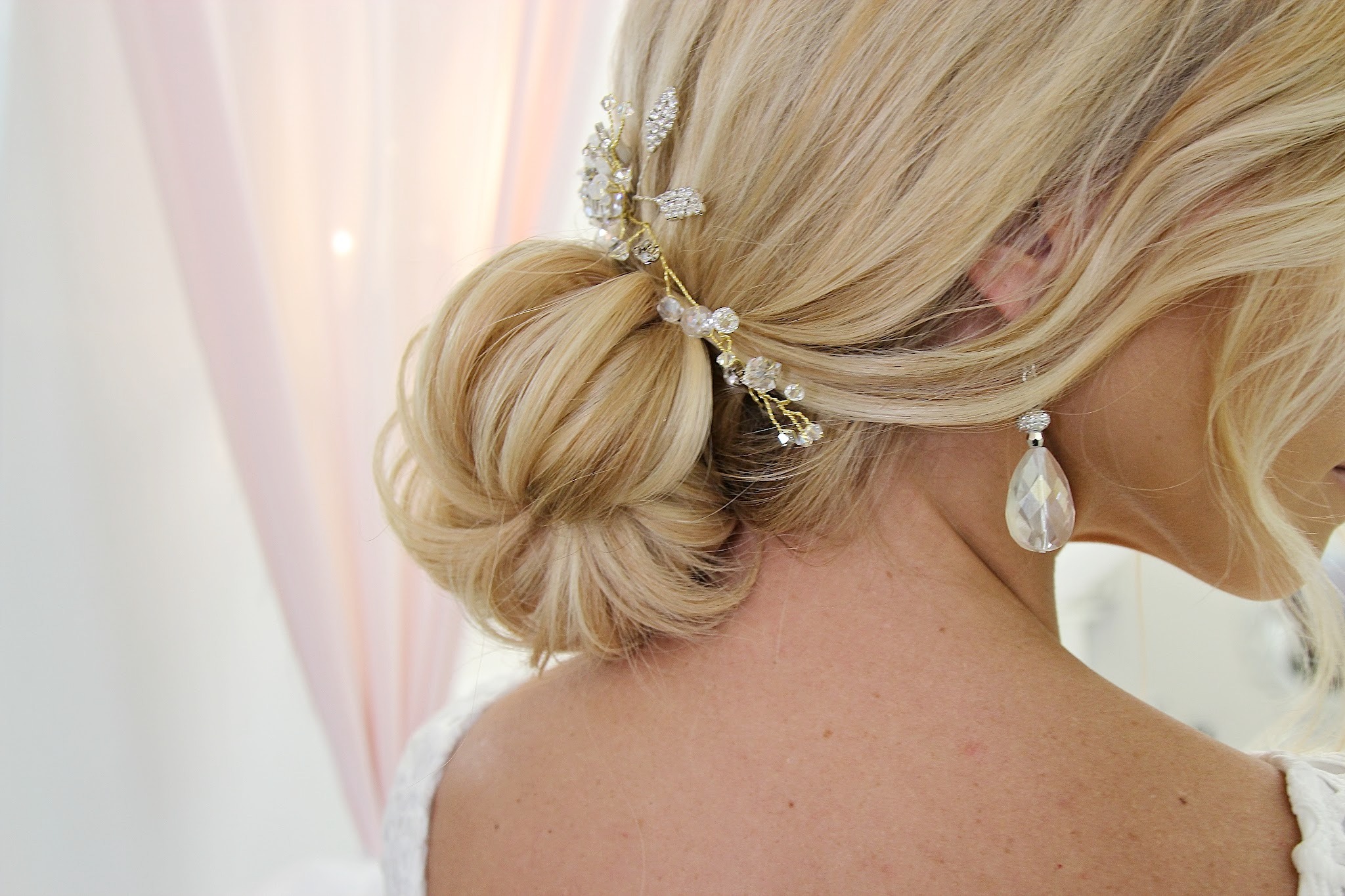
With on-site wedding hair and makeup, the team comes to your suite and the morning is scheduled backwards from your photographer’s ready-by time. Expect the team roughly 30 minutes before the first person sits, hair and makeup stations running in parallel, guests first, the bride second-to-last, and flower girls last so their look stays intact.
Almost every bride pictures the wedding morning before it happens. Robes, champagne, everyone laughing, the gown hanging on a door somewhere in soft light. That version is real — it happens most weekends. What brides rarely picture is the structure underneath it, and the structure is what makes the soft-focus version possible.
This is a walkthrough of the actual morning: when the team arrives, what the room needs to give them, who sits when and why, how touch-ups work, and what a reception restyle really takes. If you’ve already booked your team, this is the part worth reading.
The Morning Runs Backwards From One Number
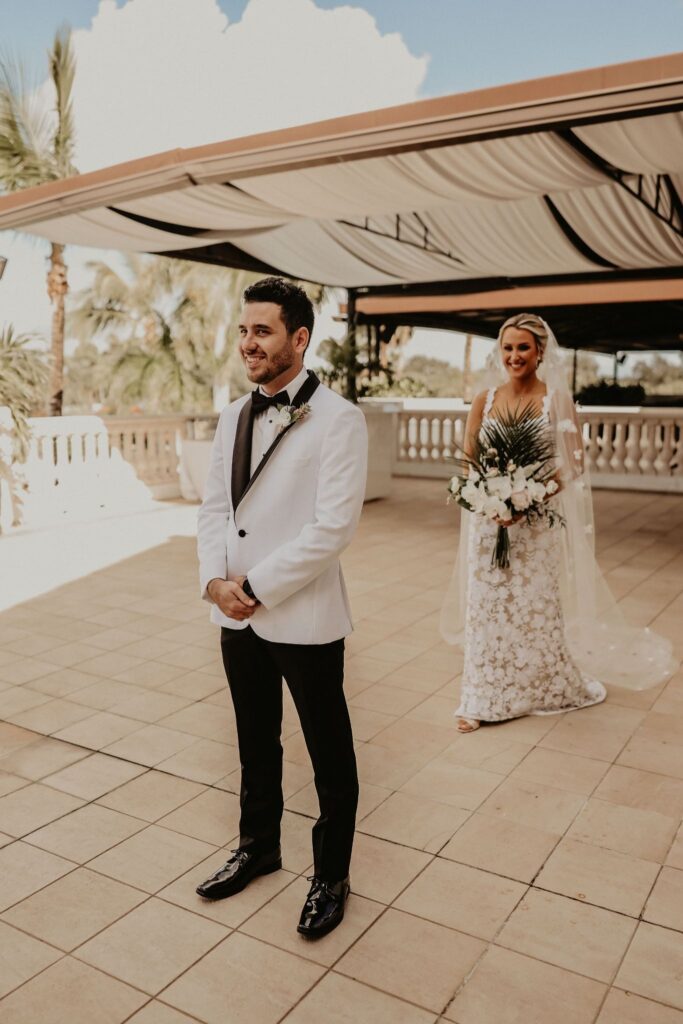
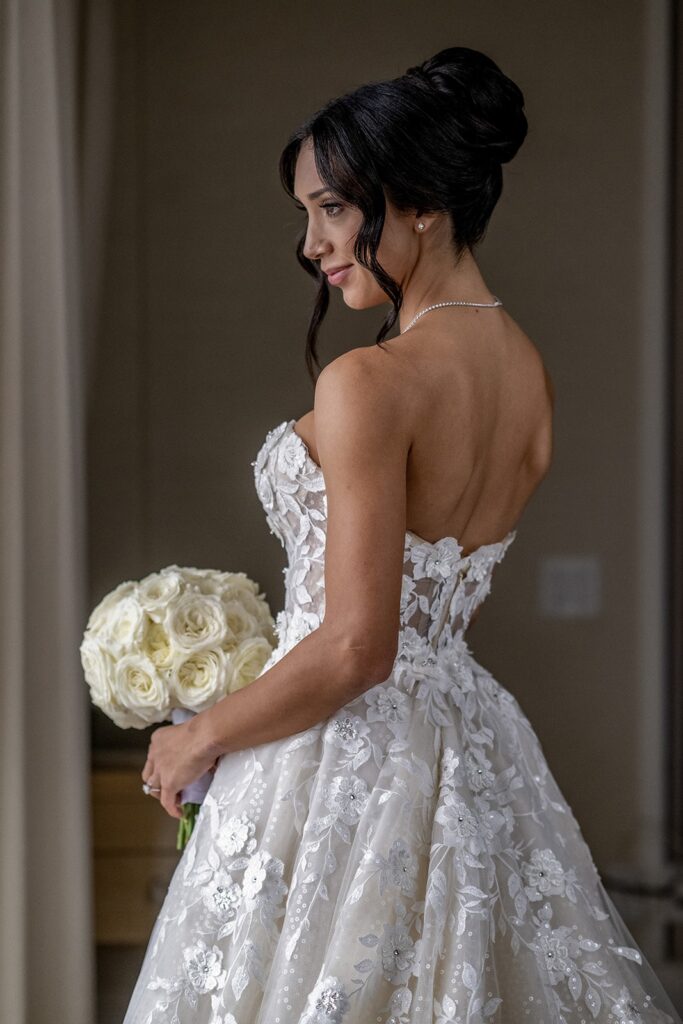
Your Photographer’s Ready-By Time Is the Anchor
Every decision about the morning starts with one figure: the time your photographer needs you finished. That’s usually driven by the first look, or by the start of getting-ready photos, or by the drive to a ceremony site.
Everything else is calculated back from there. Not forward from when you’d like to wake up.
This is worth saying plainly because brides often build the morning in the other direction — starting at a comfortable hour and hoping it lands. It rarely does. Ask your photographer for the ready-by time first, then hand that number to your beauty team and let them build the schedule around it.
How Call Time Is Calculated From Party Size
Count the services, not the people. Five bridesmaids needing hair and makeup is ten services. Add the mothers, the bride, anyone else. One artist completes roughly one to two people per hour depending on complexity, so the total service count divided by your artist count gives you the hours needed.
For a party of eight with two or three artists working in parallel, four to five hours is typical. The team arrives about thirty minutes before the first person sits.
The Buffer Nobody Budgets For
Add thirty to forty-five minutes of slack. Somebody will arrive late. Someone will change their mind about an updo halfway through. A hairstyle that was meant to take forty minutes will take an hour because the hair is finer than expected.
None of these are disasters when there’s buffer. All of them are disasters when the schedule was built to the minute.
Arrival and Setup: The First 30 Minutes
What the Team Brings In
Kits — usually one substantial case per artist. Portable lighting, because you cannot count on the room. Extension cords and power strips. Hot tools: irons, wands, dryers, sometimes a steamer. Capes, brushes, sanitising supplies. A folding chair or two if the room is short on seating.
It’s more equipment than most brides expect, and it needs somewhere to live.
What the Room Has to Give You
Natural light. A window is the single most valuable thing a getting-ready room can offer. Makeup applied under warm hotel lamps looks different in daylight and different again in photographs. Artists work beside a window whenever one exists.
Outlets. Several, accessible, not buried behind furniture. Hot tools and lighting draw real power. A suite with two reachable outlets slows the entire morning.
Table-height surfaces. A desk, a console, a dining table. Kits need to be open and reachable at working height. A low coffee table means artists working bent over for five hours.
Armless chairs. A tall chair without arms is ideal. Deep armchairs and beds are the two worst places to have hair done.
Water and space. Somewhere to fill a spray bottle, and enough floor space that two artists can work without colliding.
Why the Window Matters More Than the Chandelier
Beautiful suites are not always workable suites. A room can be stunning and still be dim, cramped, and short of outlets. If you have a choice of getting-ready rooms at your venue, choose the one with the best window and the most space — not the prettiest one. Your photographer will thank you for the same reason your beauty team will.
Setting Up Parallel Stations
Two stations, physically separated: hair on one side, makeup on the other. People move between them. This is the arrangement that makes a large morning possible, and it’s the reason a team of three is not simply three times one artist — it’s a production line, and it needs room to run.
The Running Order — Who Sits When
The order is not arbitrary. It is designed so that the people whose looks need to last longest are finished latest.
Guests and Family First
Mothers, grandmothers, aunts, anyone attending who’s receiving services. They go first for two reasons: their looks tend to be simpler, and they’re generally the least likely to disturb the schedule once finished.
Bridesmaids in the Middle
The bulk of the morning. Bridesmaids rotate between hair and makeup stations while the team works through them. This is when the room is busiest and when the buffer usually gets used.
The Bride Goes Second-to-Last
Not last. This is the correction most worth making, because “the bride goes last” is repeated everywhere and it causes real problems.
Going genuinely last leaves no room. After hair and makeup, a bride still has to get into her gown — and gowns take time, particularly anything with buttons, corsetry, or a train. She has to gather everything she’s carrying. She wants a few minutes that aren’t logistical.
Thirty minutes between finishing in the chair and walking into a first look is not enough. Being second-to-last builds that space in.
Flower Girls Go Last
Always last, and for an entirely practical reason: they will run around. A flower girl finished ninety minutes early will have touched her hair, rubbed her face, and gone outside by the time anyone notices.
Scheduled last, her look survives the walk down the aisle.
Sample Timeline: A Party of Eight
For eight people, two artists, and a 1:00 p.m. ready-by time:
| Time | What’s happening |
| 7:30 a.m. | Team arrives, sets up stations |
| 8:00 a.m. | Mothers and family begin |
| 9:15 a.m. | Bridesmaids begin rotating between stations |
| 11:30 a.m. | Bride begins |
| 12:30 p.m. | Flower girls |
| 12:45 p.m. | Bride into gown, final touches |
| 1:00 p.m. | Ready |
Your own timeline will differ — but the shape of it won’t.
What Actually Happens in Your Chair
Hair: Prep, Build, Set, Finish
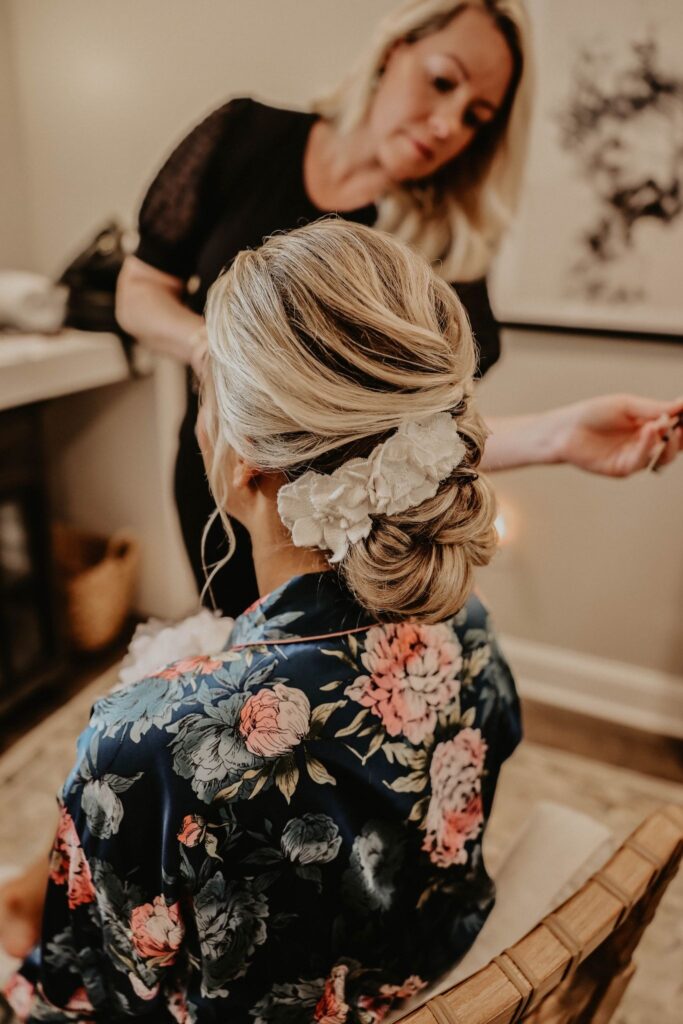
Prep comes first: the artist assesses texture and condition, and applies product depending on what the style needs. Then the build — sectioning, curling or straightening, pinning. Then setting, which is where a style earns its longevity. Then finishing: refining the shape, placing accessories, locking it in.
Extensions, if you’re wearing them, go in during the build. Bring them out beforehand, brushed and ready.
Makeup: Skin Prep, Base, Eyes, and the Photo Check
Skin prep does more for how makeup wears than any other step — cleansing, hydrating, priming for your skin type and the day’s conditions. Then base, built in layers rather than one heavy pass. Then eyes, which take the longest. Then lips, and the overall balance.
The last step is the one brides notice: the artist takes you to the window, or takes a photograph on a phone, and checks the work under real light. Makeup that looks perfect under a bathroom bulb can read differently in daylight and differently again through a lens. That check is not fussing — it’s the point.
The Veil, the Accessories, and the Final Mirror Moment
Veil placement happens after hair is finished and, ideally, after you’re in the gown. Combs, pins, and hairpieces are set at the same time.
Then the mirror. Take the moment. It’s the last quiet minute of the morning.
Touch-Ups: The Part Most Brides Don’t Plan For
What “All Day” Means — and What It Doesn’t
Most beauty teams finish the morning and leave. That’s the standard model, and it’s what the standard price reflects.
A team that stays is doing something different. They’re on site through the ceremony, available between the ceremony and portraits, and present for a reception restyle. It’s a different service and it costs differently — and the important thing is knowing which one you’ve actually booked.
Ask directly. Don’t assume.
Between Ceremony and Portraits
This is the window where touch-ups matter most. You’ve been outside. You’ve probably cried. It may have been warm. Portraits are next, and they’re the images that live on your wall.
Ten minutes with an artist here — blotting, relaying lipstick, re-pinning anything that has shifted — visibly changes the photographs that follow.
The Touch-Up Kit You Keep With You
If your team isn’t staying, ask them to leave you a small kit and to show someone how to use it. Your lip colour. Blotting papers. A few pins matched to your hair. Setting spray. Give it to whoever is carrying your things, and make sure they know they have it.
The Second Look
Reception restyles are more common than they used to be, and they’re quicker than most brides expect — as long as they’re planned.
Minimal Change: 5 to 10 Minutes
Letting an updo down slightly, softening the shape, swapping a nude lip for something bolder, adding a stronger eye. Five to ten minutes, and the difference photographs as a genuine change of mood.
Significant Restyle: 15 to 20 Minutes
Taking an updo fully down and restyling it, or building an updo from hair that was worn loose. Fifteen to twenty minutes is realistic. Beyond that you’re eating into your own reception.
Hair and Makeup Happen at the Same Time
This is what keeps the second look short. One artist works on hair while another works on makeup — not one after the other. A restyle handled sequentially takes twice as long for no reason.
Where It Happens and Who Needs to Know
You need a room — a bridal suite, a quiet side room, somewhere with a mirror and a plug. And your planner, your photographer, and your band or DJ should all know when it’s happening. A bride who disappears unannounced for twenty minutes mid-reception creates a small panic that’s entirely avoidable.
Our second look and reception hair and makeup guide covers the styling options in more depth.
What to Have Ready Before the Team Arrives
Hair washed according to your artist’s instruction — some styles hold better on second-day hair, others need it freshly clean. Ask, and follow the answer.
Skincare done. Clean, moisturised, no fresh treatments in the days beforehand.
A button-down shirt or a robe. Nothing that has to come off over a finished head.
Extensions, hair accessories, and your veil out of their packaging and accessible.
Your gown hanging and reachable, not in a bag at the back of a wardrobe.
Food and water in the room. A long morning without either is how people faint at ceremonies.
A phone charger, and a Bluetooth speaker if you want music.
One person assigned to answer the door and field deliveries — not the bride, and not the maid of honour if she’s mid-chair.
The Things That Go Wrong — and How to Prevent Them
A guest arrives late. The most common disruption by far. The fix is buffer, plus a running order that puts the least reliable timekeepers early. Tell everyone a call time fifteen minutes before their actual slot.
A suite with no usable light. Ask your venue which getting-ready room has the best window, and request it. If there’s no option, tell your team in advance so they bring additional lighting.
Not enough outlets. Ask the team to bring power strips, and check where the outlets actually are the day before rather than the morning of.
A photographer who arrives early. Common and usually harmless — but if your photographer wants detail shots at 10 a.m., the room is going to be busy. Make sure both vendors have each other’s timeline.
Tipping Your On-Site Team
Around 20% of the total service cost is customary for a bridal beauty team, in line with other personal-service vendors.
The simplest approach: put it in an envelope beforehand and hand it to the lead artist at the end of the morning, or give it to whoever is managing vendor payments for the day. Doing it in advance means it isn’t one more thing to think about while you’re getting into a gown.
How Phairis Luxury Runs the Wedding Morning
We book one event per day. Every part of the structure above depends on it — the buffer, the unhurried pacing, the fact that nobody on our team is checking a clock against a second booking.
We stay all day. Ceremony touch-ups, the window between ceremony and portraits, second-look transitions at the reception. That’s the difference between a morning appointment and what we’d call a concierge presence, and it’s the part brides tell us afterwards they hadn’t known to ask for.
Rebecca Mousseau has spent more than eighteen years doing this — 800+ brides, 5,000+ hairstyles — and the running order above is not theory. The bride second-to-last, the flower girls last, the thirty-minute buffer, the window over the chandelier: all of it is what eighteen years of wedding mornings teaches you.
We work regularly at The Breakers, Four Seasons Palm Beach, The Addison, the Biltmore, and The Colony Hotel, and we know which suites at each have the light and the space to make a morning easy.
Frequently Asked Questions
What time does on-site wedding hair and makeup start?
Work backwards from your photographer’s ready-by time. For a party of eight with two artists, that’s usually a start about five hours before, with the team arriving roughly thirty minutes earlier to set up.
Should the bride go first or last?
Second-to-last. Going genuinely last leaves no room to get into the gown, gather last-minute things, and breathe before the first look. Flower girls should be scheduled last, since a finished style rarely survives an hour of waiting.
What does the room need for on-site hair and makeup?
Natural light from a window, several accessible power outlets, table-height surfaces for kits, and armless chairs. A dim, cramped suite with one outlet slows the morning down more than anything else.
Does the hair and makeup team stay all day?
Not all do. Many finish the morning and leave. An all-day team stays on site for touch-ups between ceremony and portraits and handles second-look transitions. Ask specifically, because it isn’t standard.
How long does a reception second look take?
A minimal change — softening hair, adding a bolder lip — takes five to ten minutes. A significant restyle, like taking an updo down, takes fifteen to twenty. Hair and makeup changes happen at the same time, not one after the other.
How much should I tip the on-site hair and makeup team?
Around 20% of the total service cost is customary. Hand it to the lead artist at the end of the morning, or leave it with whoever is managing vendor payments.
Ready to Learn More?
If you haven’t booked your team yet, the questions worth asking first are in our guide to vetting a mobile wedding hair and makeup artist — travel fees, team size, contracts, and backup cover.
For a broader view of choosing an artist across the state, see how to choose a wedding hair and makeup artist in Florida. To go deeper on timing, our wedding morning beauty timeline guide breaks the schedule down further, and keeping bridal makeup fresh all day covers what happens between the morning and the last dance.
To talk about your own wedding morning, check availability here or read more about our all-day bridal beauty concierge service.
To be iconic?
Ready
I'm excited to hear all about your wedding/Event day. Have a question about a booking and hair styling sessions? View our services and talk to us, also dont forget to check our portfolio
